
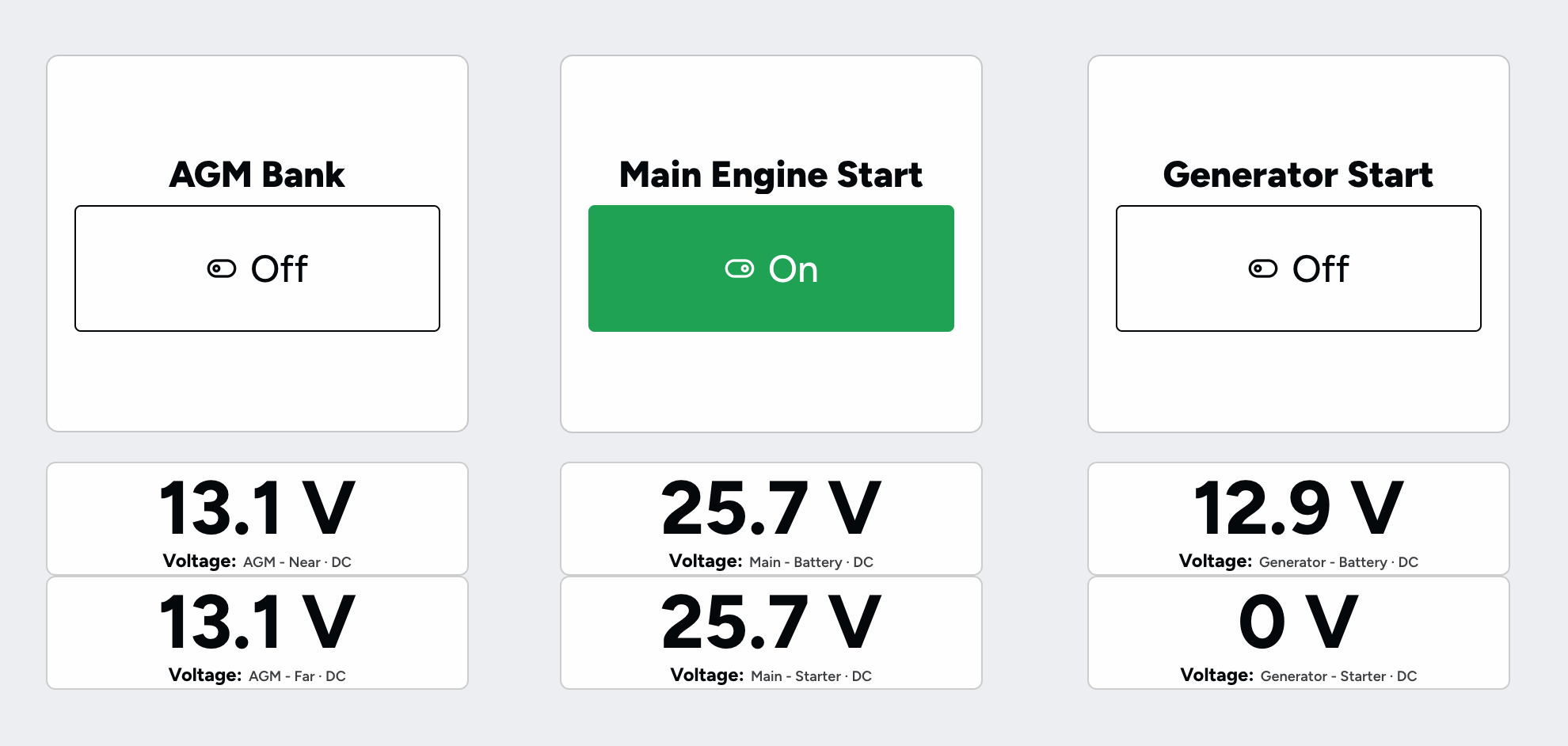
BoatKit puts electrical controls beside the information needed to use them. The example above combines AGM, main-engine, and generator controls with live battery and starter voltage, so an operator can see the result of an action without leaving the dashboard.
Compatible NMEA 2000 binary switch banks report their state through PGN 127501 and accept commands through PGN 127502. BoatKit supports EGIS Mobile Electric relays as a tested example, along with other devices that correctly advertise and implement those standard switch-control messages. Status-only banks used for alarms, activity indicators, or warning lights remain read-only instead of being presented as controls.
Marine and IoT switches, one control model
BoatKit’s Shelly integration can also discover supported devices over its vessel-local MQTT transport and bring writable two-state outputs into the same switch interface. The original device remains the authority for its reported state whether a command travels over NMEA 2000 or through the local Shelly adapter.
Administrators can rename individual channels, hide unused outputs, and choose whether a control latches on and off or operates only while pressed. Each channel can then be placed in a custom dashboard beside power, tank, machinery, camera, or navigation information. Momentary controls automatically release if BoatKit stops receiving the hold signal, and normal controls show their pending state until the device confirms the change.
Switch commands require BoatKit administrator access. Installation, circuit protection, remote-control suitability, and machinery interlocks remain subject to the connected equipment manufacturer’s requirements.